
The OYI Review · One Young India Press
Analysing the Riemann Hypothesis and the approach to solve it through Zeta Function Analysis and Quantum-Inspired Random Matrix Theory
Published 2025
Students can publish work like this with Learnacy Essential. Publication depends on review and is not guaranteed. See how
The Riemann hypothesis is one of the most famous problems in analytic number theory and mathematics as a whole and poses great implications and positive outcomes if solved. One of these many implications being the distribution of prime numbers. Prime numbers are perhaps the building blocks of mathematics and number theory and proving the Riemann hypothesis helps us understand their distribution. In the Riemann hypothesis, the nontrivial zeros of the Riemann zeta function are believed to lie on the critical line which is a part of the critical strip. Moreover, the non trivial zeros of the Riemann zeta function have spacing patterns and these patterns match the energy level spacings in chaotic quantum systems. The Random Matrix Theory shows this statistical similarity. In math, the distribution of zeta zeros matches the distribution of eigenvalues of these random matrices and therefore, If RH is true, then maybe there exists a Hermitian operator whose eigenvalues correspond to the imaginary parts of zeta zeros and since Hermitian operators have real eigenvalues, this would force all zeta zeros to lie on the critical line, this will prove RH. This paper explores this approach to prove the Riemann hypothesis through exploring the similarities of RH with random matrix statistics of the Gaussian unitary ensemble (GUE) and by exploring computational experiments of this approach.
Introduction: Prime Numbers have since their inception been one of the most fascinating parts of math and have challenged mathematicians since ages. Throughout the history of mathematics a lot of attempts have been made to find a concrete relationship or a general formula that could have described the appearance of prime numbers. The reason prime numbers are so important is because almost all numbers in mathematics can be expressed as the product of prime numbers, consequently, they are also called the building blocks of Mathematics. The attempts to analyse prime numbers go beyond history with a lot of these attempts indirectly resulting in the Riemann hypothesis. Riemann Hypothesis is essentially based on the zeta function proposed by Riemann wherein there are two types of zeroes: a) Trivial Zeroes and b) Non-Trivial Zeroes. The Trivial zeroes are not of much importance but the non trivial zeroes are the fascinating part. Now as per the hypothesis all the non trivial zeroes lie on a critical line which has the value of ½ and the critical strip ranges from 0 to 1 on the number line. The Riemann hypothesis is closely related to the prime numbers and is based on an identity of prime numbers given by Euler. Moreover, if we are able to prove that all the non-trivial zeroes lie on the critical line, we will be able to understand that the distribution of prime numbers is regular and a lot of mathematical theorems that are dependent on the assumption that the Riemann hypothesis is “true” would be proved. Now the fascinating and non intuitive relation between quantum mechanics and Riemann hypothesis is that the way zeta zeros are distributed looks exactly like the way “energy levels” of Gaussian Unitary Ensemble(GUE) are distributed in random matrices. This paper aims to delve into this approach of using Random Matrix Statistics and the correlation between GUE and the spacing of zeta zeroes of the Riemann zeta function.
The problem: The Riemann Hypothesis cannot be solved due to a single problem and that is not having a definite proof. The computers have checked over a trillion zeroes for it and all lie on the critical line but that is just not enough to come to a conclusive mathematical proof. This problem can be explained further by understanding the Riemann hypothesis by building it upon the work of other mathematicians.
The first question that needs to be answered is “Are there an infinite amount of primes?” and the answer to this is yes and this was proved by Euclid. The proof is as follows:
Theorem: There are infinitely many prime numbers.
Proof: Suppose, for contradiction, that there are only finitely many primes.
Let these primes be
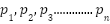
Now consider the number

- When dividing
 by a prime
 , the remainder is 1.
- Therefore,
 is not divisible by any of the primes already in our list.
Thus,  must either be a prime itself or divisible by some prime not in the list. In either case, we have found a prime not in our original collection, a contradiction. Therefore, there must be infinitely many prime numbers. But Euclid's proof only showed that there are an infinite number of prime numbers; it didn't say anything about how these primes are spread out.
To analyse the distribution of primes, Euler gave us the formula:
The Euler product formula is
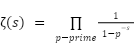
Euler’s product formula exposes the deep relationship between the prime numbers and the Riemann zeta function. This further helped us to get insights on the distribution of the prime numbers. However, there is still no proper formula governing the distribution of prime numbers.
After Euler, we had the prime number theory which further gave us insights into the distribution of prime numbers, especially large prime numbers.
Theorem: The prime number theorem gives an asymptotic form for the prime counting function, which counts the number of primes less than some integer n.


Primes become less frequent as numbers get bigger. But their “average density” is predictable:  roughly one prime every ln(x) number.
Riemann saw that the zeros of the zeta function affect how π(x) deviates from this average.
In other words the Riemann hypothesis could predict the approximation by which the prime number deviates from the PNT and could give an approximate account of when they do occur.
This implies that if RH is true, then:

The Riemann hypothesis was followed and built up on the work of these mathematicians and scientists. The hypothesis is given as:
The Riemann zeta function is the function of the complex variable s, defined in the half-plane by the absolutely convergent series:
 for

The Zeta Function is defined for the complex number  . It can also be analytically continued to almost all complex s except s=1, where it has a simple pole.
Zeroes of the Zeta function include the following:
- Trivial Zeroes: These occur at negative even integers: s =-2,-4,-6,......
- Non trivial Zeroes: These are complex numbers where s where
 <

The Riemann Hypothesis states that:

Mathematically,
 , t
 R
 Now the main problem with solving the Riemann hypothesis is that there can be an infinite number of non trivial zeroes of the Zeta function. Moreover, about 10 Trillion zeroes have been checked yet there has been mathematical definitive proof that tells us that all zeroes lie on the critical line.
Solution: The solution to this problem hasn’t been discovered yet but there is an interesting yet recently discovered way to approach this problem. This makes use of something known as Random Matrix statistics which comes under the Random matrix Theory.
Random matrix theory
In probability theory and mathematical physics, a random matrix is a matrix-valued random variable, that is, a matrix in which some or all of its entries are sampled randomly from a probability distribution. Random matrix theory (RMT) is the study of properties of random matrices, often as they become large. RMT provides techniques like mean-field theory, diagrammatic methods, the cavity method, or the replica method to compute quantities like traces, spectral densities, or scalar products between eigenvectors.
Now the relation between Random matrix theory and the Riemann Zeta function is given by the Montgomery’s Pair Correlation Conjecture.
A pair correlation function over here studies the
Montgomery's pair correlation conjecture, published in 1973, asserts that the two-point correlation function  (r) for the zeros of the Riemann zeta function zeta(z) on the critical line is
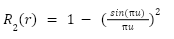
Montgomery had conjectured that if you rescale the gaps between these zeros appropriately, their distribution should follow this formula.
The formula given above was a result from the Montgomery’s Pair Correlation Conjecture mathematical conjecture, which is given as:
Under the assumption that the Riemann hypothesis is true.
Let α≤β be fixed, then the conjecture states
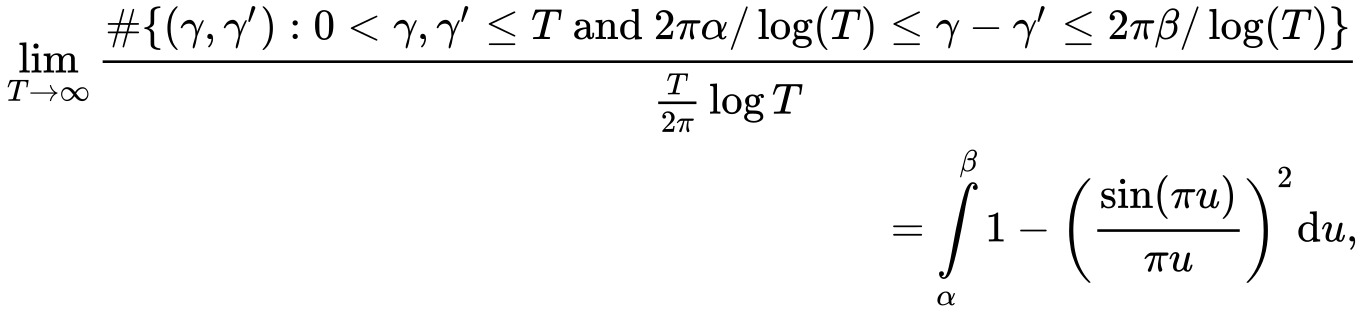
where each  is the imaginary part of the non-trivial zeros of Riemann zeta function, that is

It was then pointed out to him by physicist Freeman John that this formula is the same as the pair correlation function of random hermitian matrices. This is exactly the same formula as the pair spacing of eigenvalues in the Gaussian Unitary Ensemble (GUE) in random matrix theory.
The Gaussian Unitary ensemble is a set of hermitian matrices whose inputs are random values based on the gaussian normal distribution. Hermitian matrices always have real eigenvalues, so we can compare them directly to the real numbers.
Now when we find a similarity between the GUE and the correlation pair function of the Riemann Hypothesis it implies that since the spacing of the eigen values in the GUE are similar to the spacings of non trivial zeta zeroes then there may be a relation between them. Moreover, If RH is true, then maybe there exists a Hermitian operator whose eigenvalues correspond to the imaginary parts of zeta zeros and Since Hermitian operators have real eigenvalues, this would force all zeta zeros to lie on the critical line, this will prove RH. If we do find such a hermitian operator existing then RH will be proved.
In other words the Pair correlation of zeta zeros =Pair correlation of GUE eigenvalues.
To analyse this relation in the 1980s, mathematician Andrew Odlyzko set out to study the spacings between these zeroes through a computational approach and to test Montgomery's conjecture. This approach yielded the following results:
The following graphs show the similarity between the pair correlation of zeta zeroes and the eigenvalues of the GUE.
The scatter plot represents the observed density of spacings between zeros  for the Riemann Zeta function, with n ranging between the values written below the graph.
The solid line is the theoretical pair correlation function predicted by the Gaussian Unitary Ensemble (GUE) of random matrices.
These graphs show that there is an intricate relation between these correlation pairs from the random matrix theory and the non trivial zeroes of the Riemann Zeta function. The close match between the empirical data and the GUE prediction provides strong evidence for the connection between the zeros of the zeta function and eigenvalues of random Hermitian matrices, which was found by Montgomery as well, thus, supporting his decision.
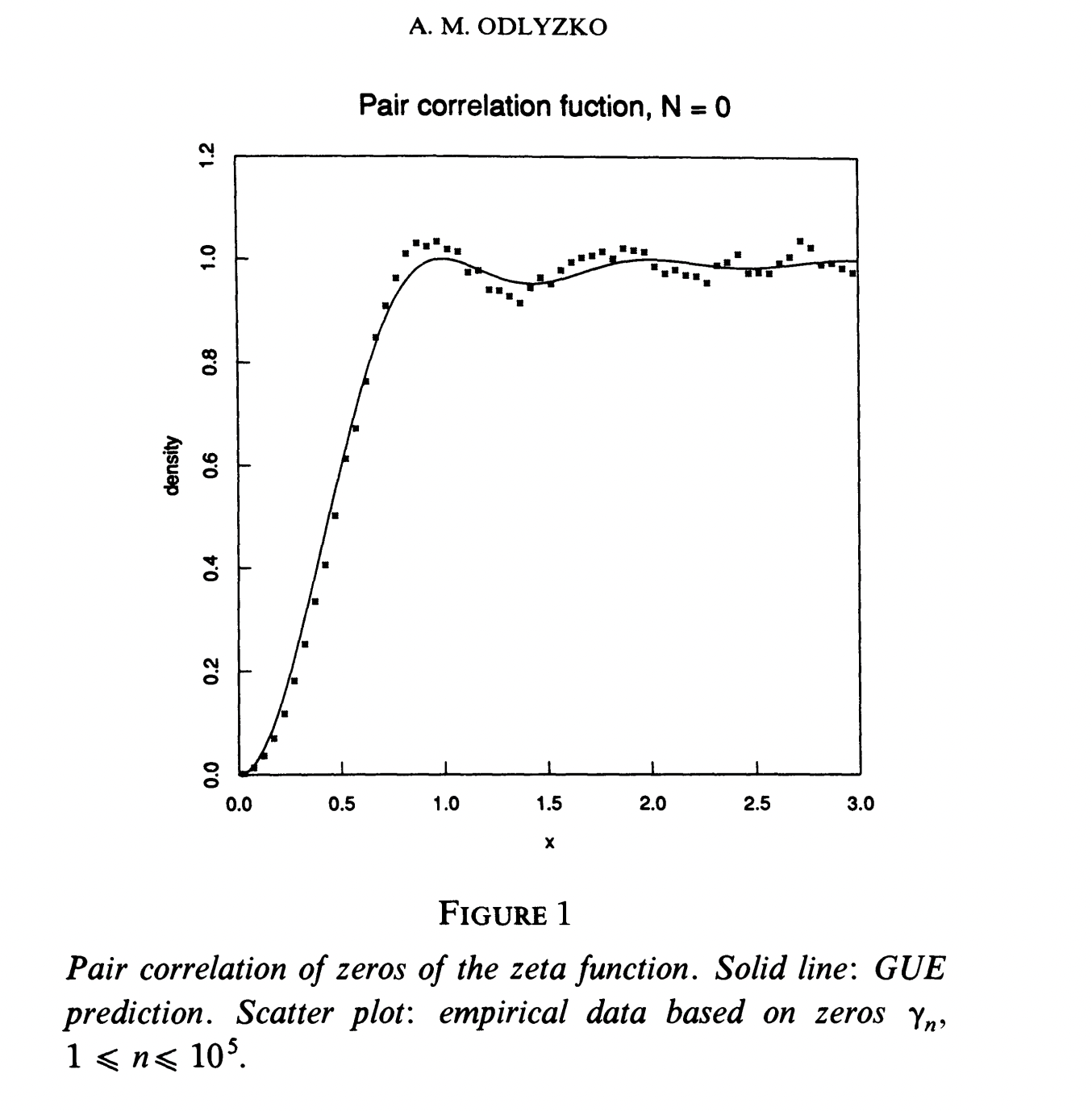
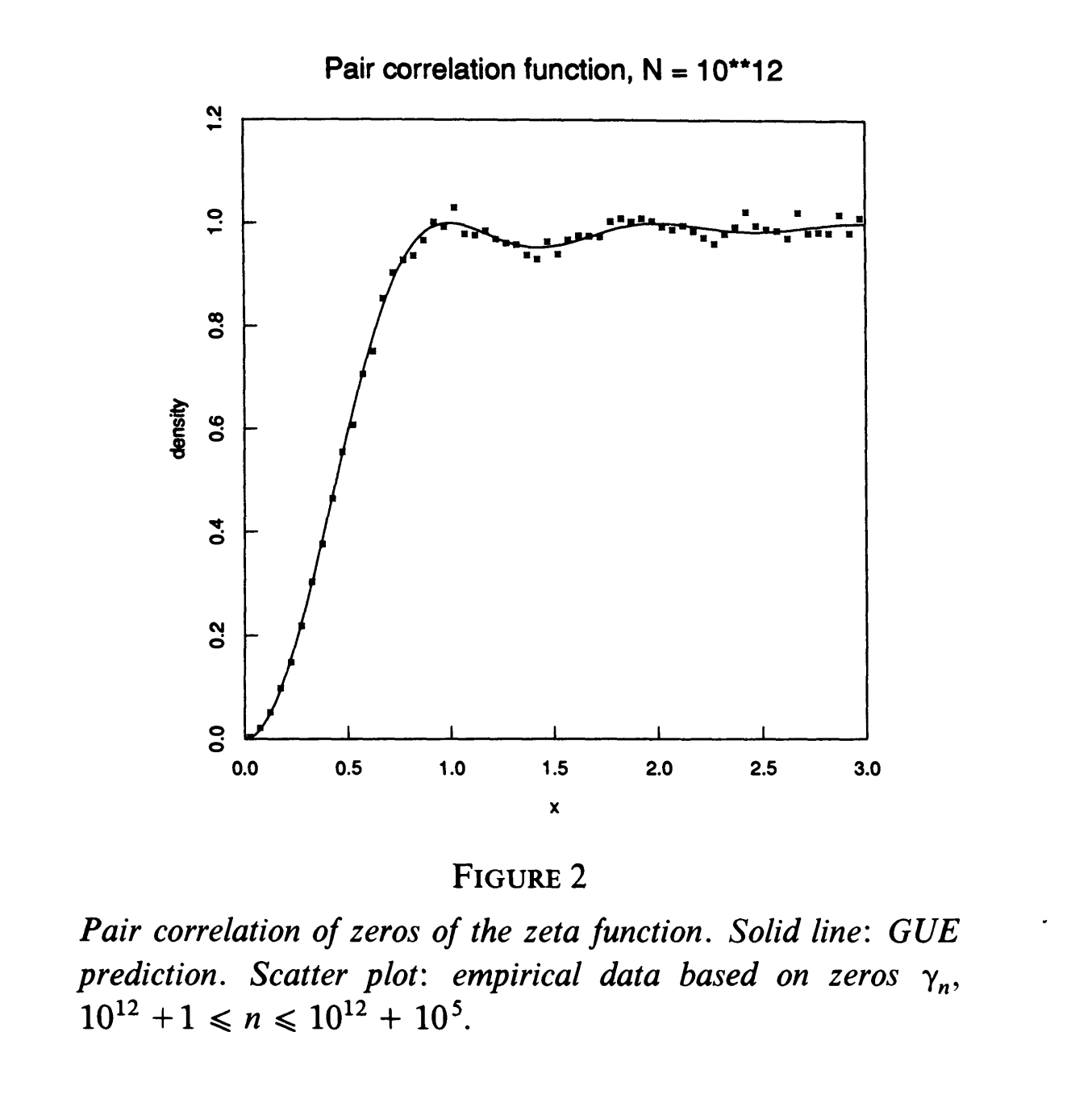
As a part of this computation and result by Odlyzko, the Montgomery-Odlyzko law (which is a law in the sense of empirical observation instead of through mathematical proof) states that the distribution of the spacing between successive nontrivial zeros of the Riemann zeta function (suitably normalized) is statistically identical with the distribution of eigenvalue spacings in a Gaussian unitary ensemble.
Current status on the Riemann hypothesis:
While the Riemann hypothesis remains one of the most famous problems after Fermat’s last theorem to be solved, we are at a critical juncture wherein the mathematical tools we need for the Riemann hypothesis haven’t been developed yet.
- The Riemann Hypothesis is still an open problem (unsolved).
- No known counterexample exists.
- Many results constrain where a counterexample could lie, or show “if RH fails, it fails under very restricted conditions.”
- Many promising lines of approach exist (operator theory, spectral methods, reformulations), but none have delivered a consensus proof yet.
- The mathematical community remains cautious about new “proof claims,” waiting for rigorous verification.
Conclusion:
The Riemann hypothesis remains one of the most important problems in Mathematics and is subtly one of the most beautiful problems if you try to study them. Moreover, this hypothesis has the potential of explaining the distribution of prime numbers, which is something crucial to understand not only for number theory but also for almost every sciences or STEM field as numbers are the language to express sciences. In conclusion, we have obviously made some new progress in coming close to solving the Riemann hypothesis, however, a lot more tools need to be developed in order to enhance and improve our understanding of the hypothesis itself. Moreover, relatively recent approaches such as the Montgomery-Odlyzko law nudge us towards finding a different approach which is non intuitive yet fascinating at the same time. With newer tools and studies being published every day, we can wait and keep on taking chances in order to solve this problem.
References
- Berry, M. V., & Keating, J. P. (1999). The Riemann zeros and eigenvalue asymptotics. SIAM Review, 41(2), 236–266. Link
- Conrey, J. B. (2003). The Riemann Hypothesis. Notices of the AMS, 50(3), 341–353. Link
- Edwards, H. M. (1974). Riemann’s Zeta Function. Dover Publications. Link
- Katz, N. M., & Sarnak, P. (1999). Random Matrices, Frobenius Eigenvalues, and Monodromy. American Mathematical Society. Link
- Mehta, M. L. (2004). Random Matrices (3rd ed.). Elsevier. Link
- Montgomery, H. L. (1973). The pair correlation of zeros of the zeta function. Analytic Number Theory, Proceedings of Symposia in Pure Mathematics, 24, 181–193. Link
- Odlyzko, A. M. (1987). On the distribution of spacings between zeros of the zeta function. Mathematics of Computation, 48(177), 273–308. Link
- Riemann, B. (1859). Über die Anzahl der Primzahlen unter einer gegebenen Größe. Monatsberichte der Berliner Akademie, 671–680. Link
- Sarnak, P. (1999). Problems of the Millennium: The Riemann Hypothesis, Clay Mathematics Institute. Link
- Titchmarsh, E. C. (1986). The Theory of the Riemann Zeta-function (2nd ed.). Oxford University Press. Link
Cite this paper
Arnav Dhiman (2025). Analysing the Riemann Hypothesis and the approach to solve it through Zeta Function Analysis and Quantum-Inspired Random Matrix Theory. The OYI Review, One Young India Press. https://www.learnacy.school/white-papers/analysing-the-riemann-hypothesis-and-the-approach-to-solve-it-through-zeta-function-analysis-and-quantum-inspired-random-matrix-theory
Publish your own work
Students can publish work like this with Learnacy Essential.
Write in the Writing Studio with guides, a rubric and citation tools. Get a scorecard and notes, revise, and submit for review. ₹1,499 a year, single payment, no automatic renewal.
Publication depends on review and is not guaranteed.
Or try the Writing Studio free for 7 days to explore it
Every programme registration also includes a year of Learnacy Essential. See programmes